Showing posts with label San Pedro. Show all posts

Monday, February 28, 2011

San Pedro Real Estate Agent Claims Albert Einstein Stole His Theory; Sues in Federal Court

In February 1931, San Pedro real estate agent Ira D. Edwards sued renowned physicist Albert Einstein in United States District Court. Edwards charged that Einstein pilfered the complex "Unified Field Theory" from Edwards' booklet entitled "The Why and Wherefore of Things" published and copyrighted in November 1929.

Albert Einstein speaking, ca. 1940
Library of Congress photo

Edwards asked the court to grant an injunction forbidding Einstein from using the unified field theory. He also wanted Einstein subpoenaed to answer the charges, and "such further relief as the court may see fit and full costs of the action."

Einstein's research associate Dr. Walther Mayer swiftly ridiculed the suit as "simply one of those annoying things that people are subjected to at times."

Professor Einstein was lecturing on the unified field theory at the Mt. Wilson Laboratories at this time, and was in fact residing at his bungalow in Pasadena when first told of Edwards' lawsuit. Einstein  remarked that "I never heard the name before," and in his formal reponse to the suit noted while his lectures were based on mathematics, Edwards' work was not. 

Stories about this lawsuit appeared in newspapers around the country.  Even Time magazine mentioned it.

Ira D. Edwards was well-known in the San Pedro business and real estate community.  As World War I was drawing to a close in 1918, Edwards, as president of the Community Association of San Pedro, worked to promote the development of the local harbor areas of his hometown, Wilmington, and Long Beach.  He was particularly interested in developing new housing for shipyard workers.

Edwards' San Pedro friends said that while they knew Edwards as a resourceful real estate dealer who had "been heard to expound ideas about the universe which they were not able to grasp," they had not read his book.

Unfortunately for San Pedro's real estate guru and would-be theoretical physicist, however, Federal judge William Cosgrave agreed with Einstein and quickly dismissed Edwards' lawsuit for copyright infringement in March 1931.

More on the unified field theory here:

Sources: Los Angeles Times, Time magazine, Billings Gazette (Montana), Bakersfield Californian, New Castle News (Pennsylvania), Nevada State Journal, Zanesville Signal (Ohio)

Sunday, February 6, 2011

Happy Birthday President Reagan -- San Pedro Remembers "the Gipper"

To commemorate what would have been Ronald Reagan's 100th birthday, I have updated with new research the following article I wrote that was published in More San Pedro (Daily Breeze) in 2008, and previously published on this blog:
----

Ronald Reagan's Visits to San Pedro and the L.A. Harbor area
Ronald Reagan was no stranger to San Pedro and the harbor area. He visited frequently decades before he was elected Governor of California in 1966 and 40th President of the United States in 1980.

Reagan first came to the area when he traveled to Catalina Island in the mid-1930s as a radio sports announcer to familiarize himself with the Chicago Cubs while they held spring training there. On November 13, 1941, just a few weeks before the attack on Pearl Harbor, he underwent a physical examination at Fort MacArthur in San Pedro. This exam stated that Reagan was “permanently incapacitated for Active Duty due to compound myopic astigmatism -- bilateral, severe – distant vision 6/200 both eyes without glasses.” He was seen during this period at the base and also with his first wife Jane Wyman at the base.

Reagan (who in 1937 was appointed a second lieutenant in the Officers’ Reserve Corps of the Calvary) went on active duty in 1942 after he passed another exam, although he was classified as limited service only. Reagan soon transferred from the Calvary to the Army Air Force (AAF). Among other assignments, he served one tour of duty as liaison officer at the Los Angeles Port of Embarkation in Wilmington, and was also the adjutant with the 18th AAF Base Unit at Culver City. On September 8, 1945, Captain Reagan was ordered to Fort MacArthur again, this time for separation, which was effective December 9, 1945. Reagan and his second wife Nancy reportedly visited the former stately Matson passenger/cargo marine terminal at Berths 195-198 in Wilmington (dedicated in 1953) during its heyday.

On October 2, 1966, while campaigning for Governor, Reagan attended San Pedro’s Fishermens' Fiesta. He praised the traditional blessing of the fleet stating: "There's a new sparkle in the waves and new gold in the summer because of this wonderful custom."  (John Mardesich's "North Pacific" boat won the competition with a Flintstones' theme.) 

On March 16, 1968, Governor Reagan officiated at the groundbreaking of the final $10.5 million link that tied the Harbor Freeway to the Vincent Thomas Bridge. Other officials at the ceremony were local Assemblyman Vincent Thomas and Los Angeles City Councilman John S. Gibson Jr.

Sources: "An American Life" by Ronald Reagan, The National Archives, Washington Post, Los Angeles Times, Long Beach Independent Press-Telegram

Monday, January 17, 2011

Smallpox invades Los Angeles; San Pedro Quarantined

   Outbreak, alarm and yellow flags

In the early months of 1887 smallpox made a deadly resurgence into California. According to the State Board of Health, this disease first appeared in the city of Los Angeles on February 16 after having been imported from Mexico. It ultimately caused fifteen deaths (from about 120 cases) in the city through June of this same year. An estimated 10,000 people fled Los Angeles to avoid contagion. From early 1887 to the end of the fiscal year on June 30, 1888, smallpox caused ninety-four deaths throughout the State.
 

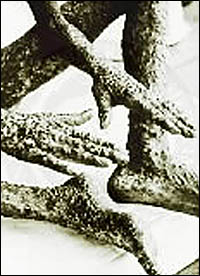
Unknown victim of milder case of smallpox (not from the 1887 L.A. epidemic). From America.gov:
"This case of smallpox was 'made mild' by a vaccination, according to the caption on this undated photo."


Unknown victim of severe smallpox
 (not from the 1887 L.A. epidemic), NLM 
  
Smallpox is a highly contagious and often fatal disease characterized by fever, rashes, pustules and scabs. The World Health Organization states that smallpox  is "one of the most devastating diseases known to humanity...decimating populations and changing the course of history." Vaccination is the only prevention.

Smallpox outbreaks have occurred for thousands of years, but the disease is now eradicated. The last case in the United States occurred in in 1949, and the last natural case in the world occurred in Somalia in 1977.

An earlier outbreak of smallpox in the City of Angels occurred during the Civil War years. The Los Angeles Star reported in November 1862 that the town's native American population had suffered seven cases of smallpox wth two deaths.  In February of the next year, the local Board of Health was aware of 319 cases of the disease.
 
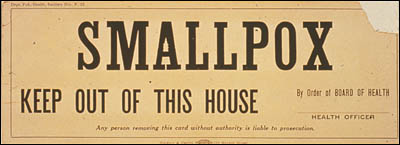
During the 1887 outbreak, houses in Los Angeles containing smallpox were ordered to be marked with yellow flags. Twenty thousand circulars about smallpox were distributed throughout California that included the following:

"After an absence of many years, smallpox has again been imported into our State...The State Board of Health feels its imperative duty to present certain suggestions and precautions...No time should be lost, but a general vaccination insisted upon...it is our great privilege to live in California, the inhabitants of which are too intelligent and well informed not to see the importance of this measure when smallpox invades their town.."

Fortunately the form of smallpox that struck Los Angeles, while prevalent, was of the mildest character. But as the State Board of Health noted at the time, if the type of this disease had not been "devoid of any epidemic tendency, the spread of this disease would have been unlimited, and the death rate consequently increased."

Quarantine poster used in CA. in the early 20th century
Although the form of smallpox was mild, the 1887  epidemic caused alarm and some panic throughout the state. California Medical Inspectors were sent to San Pedro and other state entry points to "inspect all trains and vessels, and detain every case of a suspicious nature, vaccinate all passengers exposed, etc." Dr. W.A. Weldon was assigned to San Pedro (and was later appointed local Coroner by the L.A. County Board of Supervisors).

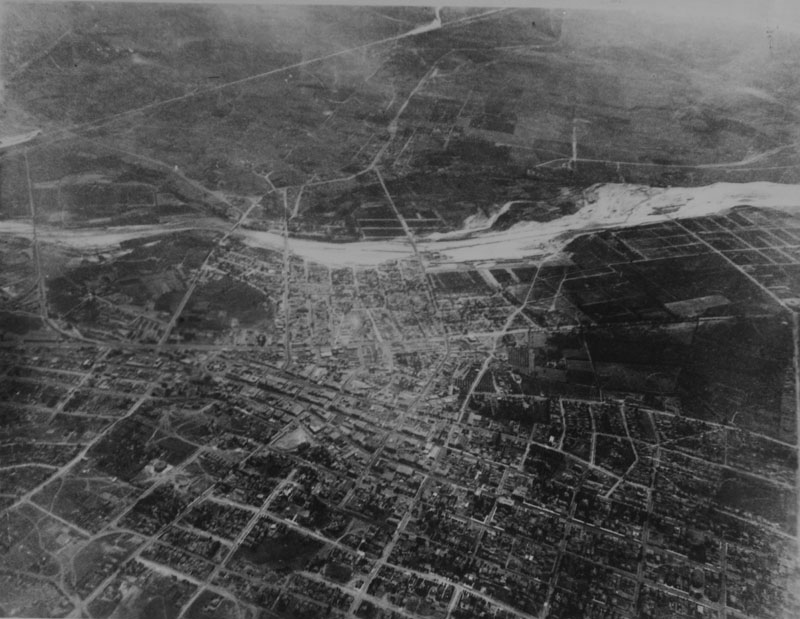
The Los Angeles area at the beginning of 1887 was doing quite well. Real estate was booming. Two transcontinental and four local railroads were running. Streets were being paved with asphalt. Businesses were opening, many schools were being built, and thousands of people from the East and elsewhere were flocking to the growing and well-sanitized city for health and pleasure. Over 45,000 people lived in the city of L.A. at this time.


Aerial photo of Los Angeles in 1887
 As might be expected, news of a smallpox outbreak was not welcome. Indeed, the local press reacted quickly and harshly against the often exagerated claims from San Francisco and elsewhere that Los Angeles was "overrun with the plague."  The Los Angeles Times emphasized the "sporadic cases" of a "mild type" of smallpox in the city, opined on the "foolish smallpox excitement," and declared the "scare entirely needless and imbecile."

Los Angeles Mayor William H. Workman in March 1887 diplomatically stated that: "Rumors of the State Board of Health, having in view the quarantining of this city, are entirely erroneous...There is no cause for alarm from smallpox in this city...The authorities are taking the most effective measures to eradicate the smallpox from our midst."

The State Board of Health, however, while acknowledging that the smallpox situation was not as dire as portrayed, nevertheless was upset with what it saw as "extreme secrecy" and lack of urgency and recogntion of potential danger from the Los Angeles press and residents.

The board complained that their "worthy efforts were belittled...Instead of cooperating and doing all in their power to throttle the disease in its first visitations, these would-be sanitarians scoffed and sneered...The result of this was to make people comparatively careless." They lamented that the local media attacked their board members in the "most shameful manner" and impugned their motives.

The "Great indignity," "vicious stab" and "infection" of L.A.;
San Pedro quarantined 

As hostile as it was to the State Board of Health, however, the Los Angeles press was even more bellicose towards the city's northern rival San Francisco, whose local Board of Health (that included San Francisco mayor Edward B. Pond) adopted this resolution in March of 1887:

"Resolved, that the city of Los Angeles be declared infected with smallpox, and as the port of San Pedro is the port of departure from that city, it be declared infected, and that all vessels arriving therefrom shall be placed in quarantine until thoroughly inspected by the quarantine officer.

The Los Angeles Times was outraged, criticizing San Francisco's "narrow-minded capitalists" and stock jobbers" that have "been ever ready to stamp this southern city into the dust."  The Times particularly criticized San Franciso's health board for its "vicious stab," "asininity" and "spite-work" for quarantining San Pedro which was as "unnecessary as vacinating the moon."  When the health board refused to lift the quarantine in early April, the Times sarcastically declared the board "refuses to redeem itself by an intermittent spark of intellect."

Lessons learned 

The State Board of Health learned two important lessons from the epidemic of smallpox in 1887: 1) while isolation and quarantine were critical, they were not were not sufficient in stopping the disease, and 2) vaccinations (as often performed at the time) offered no protection. (In Los Angeles, of the 30,000 vaccinations given during this period, at least one-third had to be given again.)  Thorough vaccination and revaccination were an "almost absolute preventative."

And despite the fact San Pedro was declared infected and quarantined -- with the State Board also reporting that the port town's sanitary condition was so "deplorable" that it could propagate contagious disease -- San Pedro suffered only one case of smallpox during this period.

Sources:

Centers for Disease Control and Prevention. Smallpox Fact Sheet, Smallpox Disease Overview.

Tenth Biennial Report of the State Board of Health of California. For the Fiscal Years from June 30, 1886, to June 30, 1888. Sacramento: State Office: J.D. Young, Supt. State Printing. 1888.

Los Angeles Star. November 1862, February 1863.

Los Angeles Times. January, February, March, April 1887.

World Health Organization. Smallpox.
Sunday, April 11, 2010

Stone Age Murder at White Point?

From the Evening News, April 10, 1919:

---


LOS ANGELES, April 10 -- Evidence of a mysterious and cowardly murder of an unidentified man has been unearthed by curators at the Exposition Park museum.

While studying a skeleton brought to them they found death had been caused by an arrow embedded in the spinal column.

"This is a particularly cowardly case," declared Edward James, detective. "This man was shot in the back. But I see no clew [sic] leading to the guilty party nor can I determine the motive."

The skelton, it might be added, was that of a cliff dweller, dug from beneath a rock 100 feet underground at White Point, near San Pedro. He was murdered during the stone age.

---

*above image shows the White Point area (near San Pedro), c. 1930

**To read more about  Stone Age Spear and Arrow Points of the Southwestern United States, click here.

Wednesday, March 31, 2010

Harbor Area Reacts to Civil War's End and President Lincoln's Assassination

Although Los Angeles had been known as a "hot bed of secession," the harbor area was jubilant at the end of the Civil War and the prospect of peace. In April 1865, a correspondent from the San Francisco Bulletin reported that "On the receipt by telegraph of the occupation of Richmond, 100 guns were fired in Wilmington, and crowds of the right kind of people perambulated the streets with torches, while the town was as bright as day with bonfires."

Wilmington is near San Pedro and is part of the Los Angeles Harbor area.

As seen throughout the country, however, this jubilation quickly turned to grief after President Abraham Lincoln was shot and died shortly thereafter on April 15, 1865.  When the telegraph of Lincoln's assassination reached Wilmington, businesses and public houses were closed and hung with crape by grief-stricken residents. 

General Phineas Banning, a successful businessman known as the "father of Wilmington," ordered his employees to suspend work on the day of Lincoln's funeral. The "heavy blows usually resounding in Banning's huge blacksmithing establishment" were temporarily silenced, and other locals followed this example and suspended work.

The Bulletin's correspondent noted that on the sacred day of Lincoln's funeral "not even a team or pleasure wagon was to be seen leaving the little town" and "it was a strange sight to see billiard tables and card-tables utterly deserted among so fun-loving a population as Wilmington contains."

While General Banning and the whole of Wilmington's population was described as having "shown themselves the true stuff," the local establishment of Tomlinson & Co. was criticized for being "utterly indifferent to the great national calamity that had just taken place" by continuing work with all their men until dark after news of Lincoln's funeral arrived -- unlike A.W. Timms who instantly closed his store and trimmed his whole establishment with black.

Wednesday, October 7, 2009

Early History of the Port of Los Angeles


Here is a map (above) and an excerpt from the Report of the Board of Engineer Officers on Deep Water Harbor at San Pedro or Santa Monica Bays, California (as reprinted in the L.A. Times on Jan. 14, 1893):


"The record of vessels wrecked at San Pedro shows, with one exception, that the disasters occurred during the southerly storms, the heavy sea coming to the eastward of Catalina Island. The vessels were driven ashore on the west line of the bay. Among those lost were the Nicholas Biddle, Callao, Adelaide Cooper, San Luis American, R.P. Buck, and the Kennebeck. The exception noted was that of the Amy, which was driven ashore at Point Firmin during a northeast storm from the Santa Ana wind gap."