Wednesday, August 3, 2011

Phineas Banning Hailed as Friend of the Workingman

In 1867, the several hundred appreciative employees of General Banning -- widely acknowledged as the founder of the Port of Los Angeles -- presented him with a fine gift. As recounted in the Wilmington Journal in February 1867:

"On Saturday evening last the employees in the different establishments of General P. Banning, wanting to testify their respect to that gentleman as the workingman's friend, presented him with a most superb watch and chain.

The instrument is of fine American manufacture, and finished in the highest style of art...The presentation was made by Capt. E.E. Hewitt...The General, in response, replied in a very happy and felicitous manner, and was several times interrupted by the applause of those present.

The testimony was worthily bestowed, and was the free-will offering of those who, knowing Gen. Banning, wished to attest their appreciation of the workingman's friend."

Sunday, June 5, 2011

San Pedro Astronaut Blasts Off Into Space

After a brief delay due to high-altitude crosswinds, former San Pedro resident Dr. Anna Lee Fisher launched into space on November 8, 1984 on board the Space Shuttle Discovery.
Anna L. Fisher, (M.D.)
NASA Astronaut, NASA photo

On this historic 8-day mission, Dr. Fisher and her fellow astronauts deployed two satellites, operated the Radiation Monitoring Equipment device, conducted an experiment for 3M Company, and completed the first space salvage mission by recovering two disabled satellies (Westar 6 and Palapa B-2).  Dr. Fisher operated the shuttle's robotic arm during the satellite rescue operation.

She also became the first mother in space.

While in space, the Discovery crew spoke with President Reagan, who asked Fisher if she would recommend a space career to her 14-month-old daughter.  She replied: "That I would Mr. President...it's truly an incredible experience..."

The Los Angeles Times reported that Dr. Fisher once had to keep secret the fact that she was pregnant.  In a training exercise, she rescued an "unconscious" crew member from the launch pad in a simulated emergency. As she recalled: "It was a hot day in Florida, and I had breathing equipment on, and I carried somebody out of the commander's seat and another guy out of the pilot's seat. And nobody knew I was pregnant."

As they prepared for descent to earth, the Discovery crew was concerned about a small amount of leftover maneuvering fuel aboard the two retrieved satellites, but a spill was considered unlikely and they would have been able to jettison the satellites if needed.  During their in-flight news conference, the astronauts said that the recovery of the two disabled satellites proved that "astronauts can move large objects by hand in the weightlessness of space."

STS 51-A crew in training with shuttle Discovery on launch pad;
October 25, 1984. Anna Lee Fisher (2nd from right) NASA photo
About a month after the successful landing, Dr. Fisher returned triumphantly to her hometown of  San Pedro where she received a very warm welcome. She addressed about 1000 students at San Pedro High School, her alma mater where she had earned the title "most likely to succeed."

Fisher (who has three degrees -- including an M.D. -- from UCLA)  stressed the importance of education, and said "Don't be afraid to dream, because there are a lot of neat opportunities out there."

She also attended a plaque dedication in her honor, a plaque located adjacent to the Los Angeles Maritime Museum that is still well-maintained twenty-seven years later. To see a recent photo of this plaque, click here.

On a personal note, I had the pleasure of meeting Anna Lee Fisher several years ago when she visited her mother Elfriede Tingle in San Pedro, when her mother still lived there.  Mrs. Tingle was my neighbor, and it's my privilege to have met and know such two wonderful and interesting people.

Dr. Anna Lee Fisher's current NASA biography here; latest Space Shuttle news here.

Sources: NASA, Los Angeles Times

Friday, March 11, 2011

Historic Tsunamis of the San Pedro Area

In light of the devastating 9.0 magnitude earthquake that just struck Japan and the resulting tsunami warnings issued for the California coast, I am republishing research I have done on two tsunamis (August 1868 and May 1960) that impacted the Port of Los Angeles:
---


A Tsunami Strikes San Pedro and Wilmington, August 1868

‘A Most Startling and Remarkable Tidal Phenomenon’

On August 14, 1868 a tsunami struck the harbor area.  A tsunami is a series of large sea waves usually caused by a large earthquake beneath the sea floor or less frequently by an underwater landslide or volcanic eruption.

For the rest of the article, click on this link and go to page 4:

 http://www.lamaritimemuseum.org/Vol_3_No_3_Winter_2007.pdf


USS Wateree
Beached at Arica, Chile, after she was washed ashore by a tidal wave on 8/13/1868

****
****

"Largest Earthquake in the World" Impacts Los Angeles Waterfront, May 1960

On May 22, 1960, a magnitude 9.5 earthquake struck south central Chile.  The United States Geological Survey calls this "the largest earthquake in the world."  In Chile, approximately 2,000 people were killed,  3000 injured, and another 2,000,000 were left homeless.


The Governor's Office of Emergency Services for California estimates that the waves generated by this massive earthquake caused about $500,000 to $1,000,000 worth of damage to the state, and notes that two people were killed.

Locally, the Los Angeles Times reported that boats and piers were smashed along San Pedro's waterfront, where a series of tidal currents surged back and forth surged through the port's narrow Cerritos Channel. Some 300 yachts and small boats were ripped from their slips, and early estimates were that 15-20 boats had sunk. The surge was estimated at up to 8-9 feet high in places at times. A strong current caused the port's Terminal Island ferry Islander to be swept off course by 300 yards, while "monumental traffic jams" occurred in both the Los Angeles and Long Beach harbor areas.

A Port of Los Angeles report states that the "Chilean earthquake and tsunami of May 1960 was the maximum event recorded in recent history to impact the Ports."

For more on this devastating earthquake, click on these links:

http://earthquake.usgs.gov/earthquakes/world/events/1960_05_22_articles.php
http://www.conservation.ca.gov/cgs/geologic_hazards/Tsunami/Pages/About_Tsunamis.aspx

Monday, February 28, 2011

San Pedro Real Estate Agent Claims Albert Einstein Stole His Theory; Sues in Federal Court

In February 1931, San Pedro real estate agent Ira D. Edwards sued renowned physicist Albert Einstein in United States District Court. Edwards charged that Einstein pilfered the complex "Unified Field Theory" from Edwards' booklet entitled "The Why and Wherefore of Things" published and copyrighted in November 1929.

Albert Einstein speaking, ca. 1940
Library of Congress photo

Edwards asked the court to grant an injunction forbidding Einstein from using the unified field theory. He also wanted Einstein subpoenaed to answer the charges, and "such further relief as the court may see fit and full costs of the action."

Einstein's research associate Dr. Walther Mayer swiftly ridiculed the suit as "simply one of those annoying things that people are subjected to at times."

Professor Einstein was lecturing on the unified field theory at the Mt. Wilson Laboratories at this time, and was in fact residing at his bungalow in Pasadena when first told of Edwards' lawsuit. Einstein  remarked that "I never heard the name before," and in his formal reponse to the suit noted while his lectures were based on mathematics, Edwards' work was not. 

Stories about this lawsuit appeared in newspapers around the country.  Even Time magazine mentioned it.

Ira D. Edwards was well-known in the San Pedro business and real estate community.  As World War I was drawing to a close in 1918, Edwards, as president of the Community Association of San Pedro, worked to promote the development of the local harbor areas of his hometown, Wilmington, and Long Beach.  He was particularly interested in developing new housing for shipyard workers.

Edwards' San Pedro friends said that while they knew Edwards as a resourceful real estate dealer who had "been heard to expound ideas about the universe which they were not able to grasp," they had not read his book.

Unfortunately for San Pedro's real estate guru and would-be theoretical physicist, however, Federal judge William Cosgrave agreed with Einstein and quickly dismissed Edwards' lawsuit for copyright infringement in March 1931.

More on the unified field theory here:

Sources: Los Angeles Times, Time magazine, Billings Gazette (Montana), Bakersfield Californian, New Castle News (Pennsylvania), Nevada State Journal, Zanesville Signal (Ohio)

Sunday, February 6, 2011

Happy Birthday President Reagan -- San Pedro Remembers "the Gipper"

To commemorate what would have been Ronald Reagan's 100th birthday, I have updated with new research the following article I wrote that was published in More San Pedro (Daily Breeze) in 2008, and previously published on this blog:
----

Ronald Reagan's Visits to San Pedro and the L.A. Harbor area
Ronald Reagan was no stranger to San Pedro and the harbor area. He visited frequently decades before he was elected Governor of California in 1966 and 40th President of the United States in 1980.

Reagan first came to the area when he traveled to Catalina Island in the mid-1930s as a radio sports announcer to familiarize himself with the Chicago Cubs while they held spring training there. On November 13, 1941, just a few weeks before the attack on Pearl Harbor, he underwent a physical examination at Fort MacArthur in San Pedro. This exam stated that Reagan was “permanently incapacitated for Active Duty due to compound myopic astigmatism -- bilateral, severe – distant vision 6/200 both eyes without glasses.” He was seen during this period at the base and also with his first wife Jane Wyman at the base.

Reagan (who in 1937 was appointed a second lieutenant in the Officers’ Reserve Corps of the Calvary) went on active duty in 1942 after he passed another exam, although he was classified as limited service only. Reagan soon transferred from the Calvary to the Army Air Force (AAF). Among other assignments, he served one tour of duty as liaison officer at the Los Angeles Port of Embarkation in Wilmington, and was also the adjutant with the 18th AAF Base Unit at Culver City. On September 8, 1945, Captain Reagan was ordered to Fort MacArthur again, this time for separation, which was effective December 9, 1945. Reagan and his second wife Nancy reportedly visited the former stately Matson passenger/cargo marine terminal at Berths 195-198 in Wilmington (dedicated in 1953) during its heyday.

On October 2, 1966, while campaigning for Governor, Reagan attended San Pedro’s Fishermens' Fiesta. He praised the traditional blessing of the fleet stating: "There's a new sparkle in the waves and new gold in the summer because of this wonderful custom."  (John Mardesich's "North Pacific" boat won the competition with a Flintstones' theme.) 

On March 16, 1968, Governor Reagan officiated at the groundbreaking of the final $10.5 million link that tied the Harbor Freeway to the Vincent Thomas Bridge. Other officials at the ceremony were local Assemblyman Vincent Thomas and Los Angeles City Councilman John S. Gibson Jr.

Sources: "An American Life" by Ronald Reagan, The National Archives, Washington Post, Los Angeles Times, Long Beach Independent Press-Telegram

Monday, January 17, 2011

Smallpox invades Los Angeles; San Pedro Quarantined

   Outbreak, alarm and yellow flags

In the early months of 1887 smallpox made a deadly resurgence into California. According to the State Board of Health, this disease first appeared in the city of Los Angeles on February 16 after having been imported from Mexico. It ultimately caused fifteen deaths (from about 120 cases) in the city through June of this same year. An estimated 10,000 people fled Los Angeles to avoid contagion. From early 1887 to the end of the fiscal year on June 30, 1888, smallpox caused ninety-four deaths throughout the State.
 

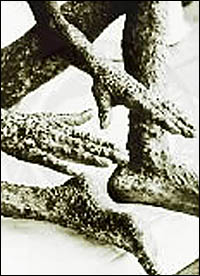
Unknown victim of milder case of smallpox (not from the 1887 L.A. epidemic). From America.gov:
"This case of smallpox was 'made mild' by a vaccination, according to the caption on this undated photo."


Unknown victim of severe smallpox
 (not from the 1887 L.A. epidemic), NLM 
  
Smallpox is a highly contagious and often fatal disease characterized by fever, rashes, pustules and scabs. The World Health Organization states that smallpox  is "one of the most devastating diseases known to humanity...decimating populations and changing the course of history." Vaccination is the only prevention.

Smallpox outbreaks have occurred for thousands of years, but the disease is now eradicated. The last case in the United States occurred in in 1949, and the last natural case in the world occurred in Somalia in 1977.

An earlier outbreak of smallpox in the City of Angels occurred during the Civil War years. The Los Angeles Star reported in November 1862 that the town's native American population had suffered seven cases of smallpox wth two deaths.  In February of the next year, the local Board of Health was aware of 319 cases of the disease.
 
During the 1887 outbreak, houses in Los Angeles containing smallpox were ordered to be marked with yellow flags. Twenty thousand circulars about smallpox were distributed throughout California that included the following:

"After an absence of many years, smallpox has again been imported into our State...The State Board of Health feels its imperative duty to present certain suggestions and precautions...No time should be lost, but a general vaccination insisted upon...it is our great privilege to live in California, the inhabitants of which are too intelligent and well informed not to see the importance of this measure when smallpox invades their town.."

Fortunately the form of smallpox that struck Los Angeles, while prevalent, was of the mildest character. But as the State Board of Health noted at the time, if the type of this disease had not been "devoid of any epidemic tendency, the spread of this disease would have been unlimited, and the death rate consequently increased."

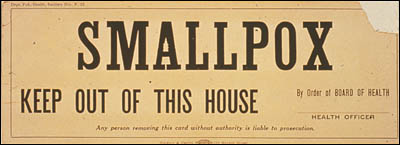
Quarantine poster used in CA. in the early 20th century
Although the form of smallpox was mild, the 1887  epidemic caused alarm and some panic throughout the state. California Medical Inspectors were sent to San Pedro and other state entry points to "inspect all trains and vessels, and detain every case of a suspicious nature, vaccinate all passengers exposed, etc." Dr. W.A. Weldon was assigned to San Pedro (and was later appointed local Coroner by the L.A. County Board of Supervisors).

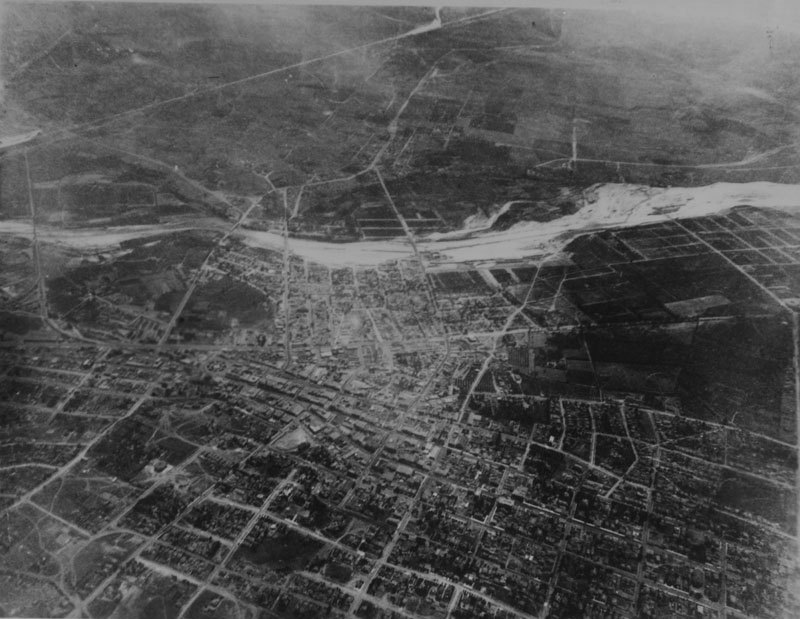
The Los Angeles area at the beginning of 1887 was doing quite well. Real estate was booming. Two transcontinental and four local railroads were running. Streets were being paved with asphalt. Businesses were opening, many schools were being built, and thousands of people from the East and elsewhere were flocking to the growing and well-sanitized city for health and pleasure. Over 45,000 people lived in the city of L.A. at this time.


Aerial photo of Los Angeles in 1887
 As might be expected, news of a smallpox outbreak was not welcome. Indeed, the local press reacted quickly and harshly against the often exagerated claims from San Francisco and elsewhere that Los Angeles was "overrun with the plague."  The Los Angeles Times emphasized the "sporadic cases" of a "mild type" of smallpox in the city, opined on the "foolish smallpox excitement," and declared the "scare entirely needless and imbecile."

Los Angeles Mayor William H. Workman in March 1887 diplomatically stated that: "Rumors of the State Board of Health, having in view the quarantining of this city, are entirely erroneous...There is no cause for alarm from smallpox in this city...The authorities are taking the most effective measures to eradicate the smallpox from our midst."

The State Board of Health, however, while acknowledging that the smallpox situation was not as dire as portrayed, nevertheless was upset with what it saw as "extreme secrecy" and lack of urgency and recogntion of potential danger from the Los Angeles press and residents.

The board complained that their "worthy efforts were belittled...Instead of cooperating and doing all in their power to throttle the disease in its first visitations, these would-be sanitarians scoffed and sneered...The result of this was to make people comparatively careless." They lamented that the local media attacked their board members in the "most shameful manner" and impugned their motives.

The "Great indignity," "vicious stab" and "infection" of L.A.;
San Pedro quarantined 

As hostile as it was to the State Board of Health, however, the Los Angeles press was even more bellicose towards the city's northern rival San Francisco, whose local Board of Health (that included San Francisco mayor Edward B. Pond) adopted this resolution in March of 1887:

"Resolved, that the city of Los Angeles be declared infected with smallpox, and as the port of San Pedro is the port of departure from that city, it be declared infected, and that all vessels arriving therefrom shall be placed in quarantine until thoroughly inspected by the quarantine officer.

The Los Angeles Times was outraged, criticizing San Francisco's "narrow-minded capitalists" and stock jobbers" that have "been ever ready to stamp this southern city into the dust."  The Times particularly criticized San Franciso's health board for its "vicious stab," "asininity" and "spite-work" for quarantining San Pedro which was as "unnecessary as vacinating the moon."  When the health board refused to lift the quarantine in early April, the Times sarcastically declared the board "refuses to redeem itself by an intermittent spark of intellect."

Lessons learned 

The State Board of Health learned two important lessons from the epidemic of smallpox in 1887: 1) while isolation and quarantine were critical, they were not were not sufficient in stopping the disease, and 2) vaccinations (as often performed at the time) offered no protection. (In Los Angeles, of the 30,000 vaccinations given during this period, at least one-third had to be given again.)  Thorough vaccination and revaccination were an "almost absolute preventative."

And despite the fact San Pedro was declared infected and quarantined -- with the State Board also reporting that the port town's sanitary condition was so "deplorable" that it could propagate contagious disease -- San Pedro suffered only one case of smallpox during this period.

Sources:

Centers for Disease Control and Prevention. Smallpox Fact Sheet, Smallpox Disease Overview.

Tenth Biennial Report of the State Board of Health of California. For the Fiscal Years from June 30, 1886, to June 30, 1888. Sacramento: State Office: J.D. Young, Supt. State Printing. 1888.

Los Angeles Star. November 1862, February 1863.

Los Angeles Times. January, February, March, April 1887.

World Health Organization. Smallpox.
Thursday, September 30, 2010

"Greatest Heavyweight Boxing Champion" Jim Jeffries Trains in San Pedro

Click on photo to enlarge
James J. Jeffries, considered by many to be the greatest heavyweight boxing champion of the early twentieth century and one of the greatest of all time, was no stranger to San Pedro and the Los Angeles Harbor area.

Born in Ohio in 1875, he moved with his family to Los Angeles at a young age, and lived in the area for the rest of his life.  He was nicknamed "The Boilermaker" because he had worked as one for the Lacey Manufacturing Company during his early pugilistic days.

Jim Jeffries knocked out Bob Fitzsimmons on June 9, 1899 to win the world's heavyweight title. Jeffries retired undefeated in 1905, but mounted a comeback against famed heavyweight champ Jack Johnson in July 1910, who stopped Jeffries in the 15th round in the "Battle of the Century."


Johnson would later say that "When I faced Jeffries in the ring I had a feeling of fear come over me for the only time in my life. It was a horrible sensation."

Jeffries retired and lived in Burbank, where he died at the age of 77 in 1953. At the time of his death, his sister Mrs. Millian Metcalf was reported to be living in San Pedro, along with his brother Jack.

Newspaper accounts from the time document Jeffries' many trips to San Pedro. For example, in July of 1899, Jeffries visited his friends and brothers and took a cruise on the steamer J.C. Elliott. He also demonstrated his well-known physical strength on this trip when he visited a blacksmith shop, and with a few blows from a sledgehammer, severed a piece of heavy iron shafting that was ready to be cut.

In March of 1900, Jeffries did some preliminary training in San Pedro for his upcoming fight with fellow boxing legend "Gentleman" Jim Corbett (Jeffries knocked Corbett out in the 23rd round). Jeffries later recounted that he would run 12-15 miles a day while in training.

After his training for the Corbett fight, he left the port for Catalina Island. A couple of years later, in March of 1902, Jeffries visited friends in San Pedro, intending to go on to Catalina.

On February 27, 1910, while preparing for his upcoming epic battle with Johnson, Jeffries took a day off and again went to San Pedro. Jeffries visited his close friend Luke Kelly, a prominent San Pedro citizen and saloon keeper. They had previously enjoyed many fishing trips in the area, but on this day they spent a quiet afternoon at Kelly's house. They later went to a local half-way house for an Italian dinner, where about a dozen San Pedran sportsmen were invited.

Top left photo: Jim Jeffries holding jump rope in unknown athletic ring; photo credit:
Library of Congress, Prints & Photographs Division, [reproduction number, e.g., LC-B2-1234]

Sunday, April 11, 2010

Stone Age Murder at White Point?

From the Evening News, April 10, 1919:

---


LOS ANGELES, April 10 -- Evidence of a mysterious and cowardly murder of an unidentified man has been unearthed by curators at the Exposition Park museum.

While studying a skeleton brought to them they found death had been caused by an arrow embedded in the spinal column.

"This is a particularly cowardly case," declared Edward James, detective. "This man was shot in the back. But I see no clew [sic] leading to the guilty party nor can I determine the motive."

The skelton, it might be added, was that of a cliff dweller, dug from beneath a rock 100 feet underground at White Point, near San Pedro. He was murdered during the stone age.

---

*above image shows the White Point area (near San Pedro), c. 1930

**To read more about  Stone Age Spear and Arrow Points of the Southwestern United States, click here.

Wednesday, March 31, 2010

Harbor Area Reacts to Civil War's End and President Lincoln's Assassination

Although Los Angeles had been known as a "hot bed of secession," the harbor area was jubilant at the end of the Civil War and the prospect of peace. In April 1865, a correspondent from the San Francisco Bulletin reported that "On the receipt by telegraph of the occupation of Richmond, 100 guns were fired in Wilmington, and crowds of the right kind of people perambulated the streets with torches, while the town was as bright as day with bonfires."

Wilmington is near San Pedro and is part of the Los Angeles Harbor area.

As seen throughout the country, however, this jubilation quickly turned to grief after President Abraham Lincoln was shot and died shortly thereafter on April 15, 1865.  When the telegraph of Lincoln's assassination reached Wilmington, businesses and public houses were closed and hung with crape by grief-stricken residents. 

General Phineas Banning, a successful businessman known as the "father of Wilmington," ordered his employees to suspend work on the day of Lincoln's funeral. The "heavy blows usually resounding in Banning's huge blacksmithing establishment" were temporarily silenced, and other locals followed this example and suspended work.

The Bulletin's correspondent noted that on the sacred day of Lincoln's funeral "not even a team or pleasure wagon was to be seen leaving the little town" and "it was a strange sight to see billiard tables and card-tables utterly deserted among so fun-loving a population as Wilmington contains."

While General Banning and the whole of Wilmington's population was described as having "shown themselves the true stuff," the local establishment of Tomlinson & Co. was criticized for being "utterly indifferent to the great national calamity that had just taken place" by continuing work with all their men until dark after news of Lincoln's funeral arrived -- unlike A.W. Timms who instantly closed his store and trimmed his whole establishment with black.

Saturday, March 13, 2010

Deadman's Island: British Whaling Captain Hanged by Mutineers


Deadman’s Island was a San Pedro landmark, a rocky isle about 800-feet long, 250-feet wide, and over 60-feet high that guarded the entrance to Los Angeles Harbor. It was removed in the late 1920s to make room for large ships in the growing harbor.

The following story is from the Evening News, June 1901:
---

Hanged by Mutineers
Pieces of Rope Found Clinging to Captain's Crumbling Skeleton

San Pedro, Cal, June 7 -- Through the caving down of a bank and the discovery of a mass of crumbling human bones a clew has been bound [sic] to a mystery that has existed for over a century.

A hundred years ago the captain of a British whaling ship, lying off this port, was killed by his crew, which mutinied.

It was known that they buried him on Deadman's Island, but the manner in which they accomplished the killing was kept a secret and, although in later years the subject was one of much inquiry, the direct cause of death was never determined.

Gradually the sea has washed away the base of Deadman's Island, which stands near the entrance to the inner harbor, and the upper part has kept caving away.

A party of boys fishing near the place Wednesday discovered the contents of the grave, which had fallen by the caving away of the bank.

The bones had fallen only a short distance from their resting place, so that the arrangement was only partly destroyed.

Although solid, as if preserved by the dryness of the sandy soil, the bones were greatly yellowed, showing
that they had been resting there probably a hundred years.

Looking more closely the boys found an old rope, rotted with age, wound about the skeleton, between the head and ribs.

The rope was of the size used by hangmen.

The discovery is taken to indicate that the unfortunate skipper was hanged by his crew, and that they buried him without removing the rope, with which he had been hanged.